Thank you for sharing your photos - this is exactly what this project is all about! :-)
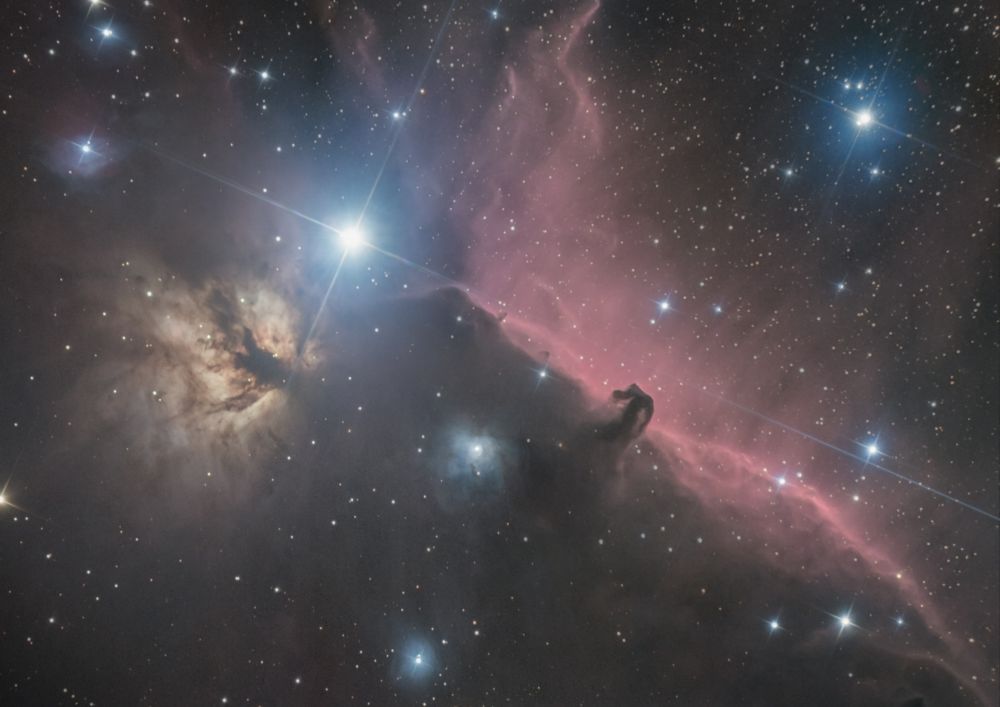
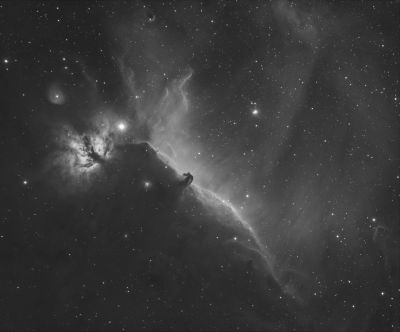
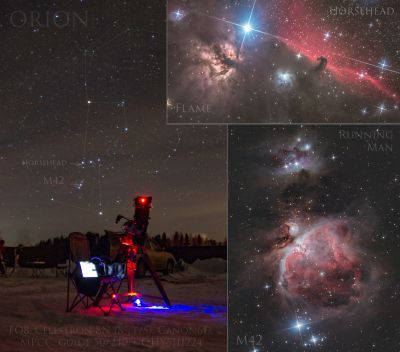
The Horsehead Nebula (IC 434, Barnard 33, also known as the "Horse's Head") is a dark nebula in the constellation Orion. The nebula is approximately 3.5 light-years in diameter and is located south of Alnitak (ζ Orionis), the easternmost star of Orion's Belt. It is part of the Orion Molecular Cloud Complex—a vast, star-forming region of gas and dust that surrounds the Orion Nebula, which lies at a distance of about 1,300 light-years.
The Horsehead is one of the most famous nebulae. It appears as a dark, horsehead-shaped silhouette against a backdrop of red glowing gas. This glow is caused by the ionization of hydrogen clouds behind the nebula, energized by radiation from the nearby bright star Alnitak (ζ Orionis). The dark appearance of the nebula is primarily due to light being absorbed by a dense layer of dust, although there are areas (visible in photos on the left) that are cast in shadow by the base of the Horsehead's "neck." Gas streaming away from the nebula moves within a strong magnetic field. The bright spots at the base of the Horsehead Nebula are young stars in the process of formation. The nebula was first discovered in 1888 on photographic plates taken at the Harvard College Observatory.
The Horsehead Nebula (IC 434, Barnard 33, also known as the "Horse's Head") is a dark nebula in the constellation Orion. The nebula is approximately 3.5 light-y…

Comments
There are no comments on this picture yet
Comments are available only to registered users. Register or log in to leave a comment.