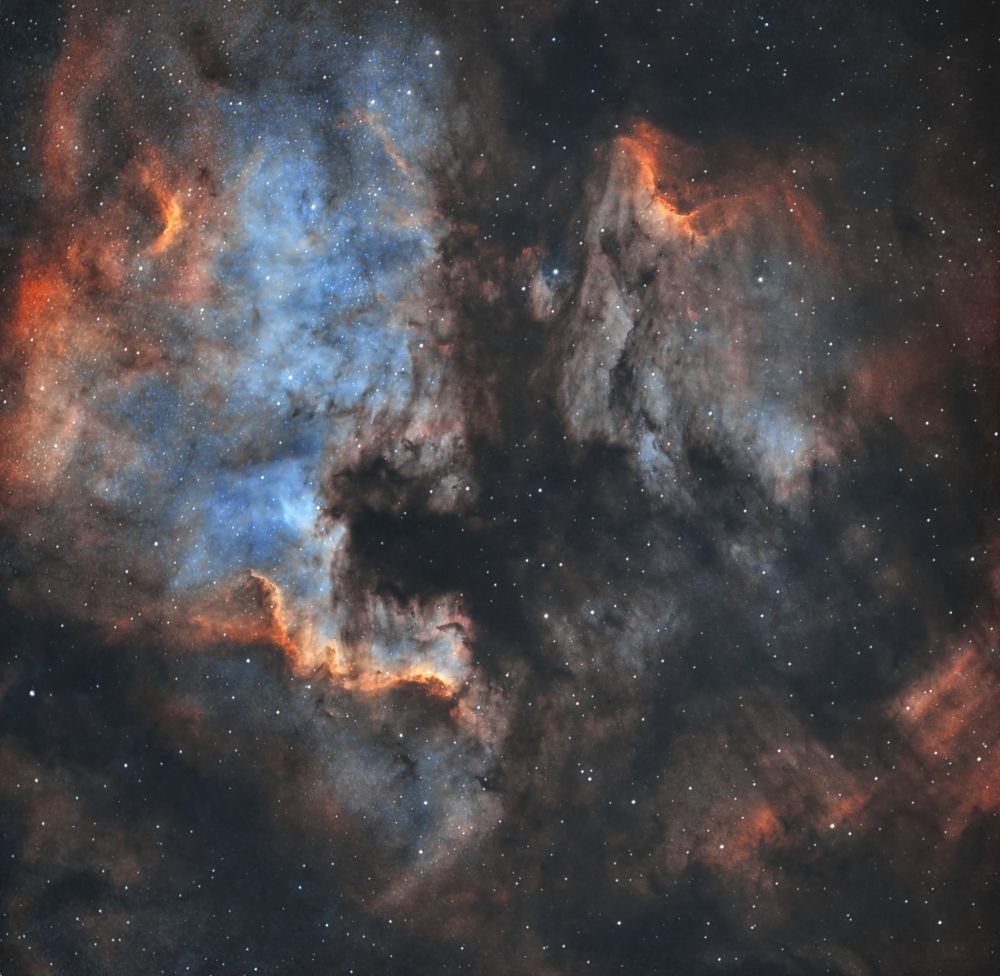
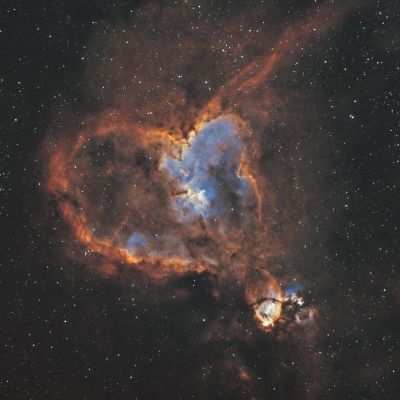
Thank you! Bicolor is the combination of only hydrogen and oxygen. The Optolong L-eXtreme filter captures in both ranges at once. In the red channel, you get hydrogen, and in the blue and green channels, oxygen. For a color camera, the image is first split into channels, as if it were shot with a monochrome camera, and then the rest of the process follows. For the Hubble palette, sulfur is missing; in this case, it is simulated using the luminance channel.
There are various videos on YouTube. Several stacking variations, but for PixInsight. I haven't looked for ones for Photoshop. And I don't know of any in Russian.
https://www.youtube.com/watch?v=740ZLTe95eg&ab_channel=Cuiv%2CTheLazyGeek
https://www.youtube.com/watch?v=1OoCtt6VPHw&t=4s&ab_channel=Cuiv%2CTheLazyGeek
https://www.youtube.com/watch?v=E5V1tZ3QlYY&ab_channel=VisibleDark
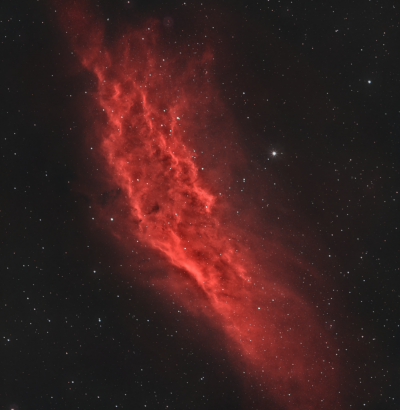
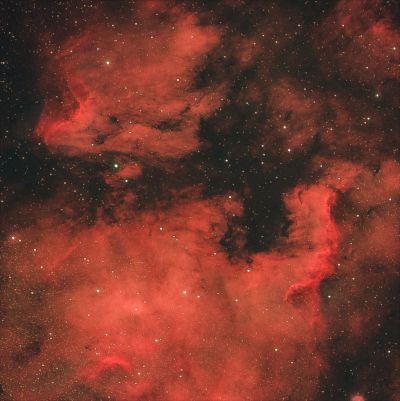
Plus, it seems this method isn't suitable for all objects. Since it's shot with a color camera, the oxygen signal is quite weak. I tried processing the California Nebula this way—it didn't turn out as a striking photo; the hue changed, but no oxygen is visible on the side of the nebula. I also tried it on M16, the Eagle Nebula, and it didn't work either, though I have relatively little total integration time on that target. I haven't tried the Heart Nebula yet.



Comments
Quick question: what is bicolor and how do you get it? A link would be great.
https://www.youtube.com/watch?v=740ZLTe95eg&ab_channel=Cuiv%2CTheLazyGeek
https://www.youtube.com/watch?v=1OoCtt6VPHw&t=4s&ab_channel=Cuiv%2CTheLazyGeek
https://www.youtube.com/watch?v=E5V1tZ3QlYY&ab_channel=VisibleDark
Comments are available only to registered users. Register or log in to leave a comment.