Thank you for sharing your photos - this is exactly what this project is all about! :-)
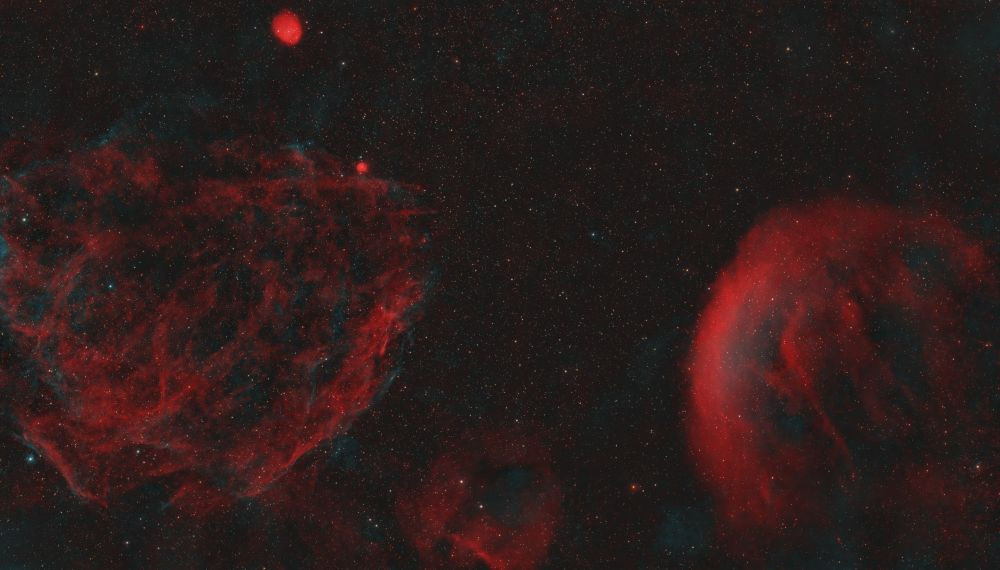
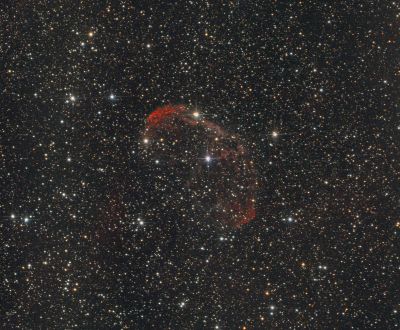
Extremely faint objects, especially for winter and an orange light pollution zone.
A dual-cannon setup on a single mount.
1. Askar SQA55 55mm f/4.8 telescope with a Touptek IMX571 C camera and an Optolong L-Ultimate filter.
2. Samyang 135mm f/2.0 ED lens with a QHY5III585M camera and a Touptek AFW 8×1.25" filter wheel.
I tried to synchronize the two scopes, but after losing a night, I realized it was nonsense—the cameras wouldn’t wait for each other.
So, I ran one with 10-minute subs and dithering every 3 frames, and the other with 5-minute subs, ending up with about every 6th frame from that camera in the trash.
Now about the object—it’s on AstroBin but not here.
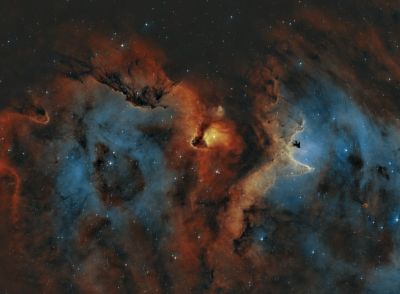
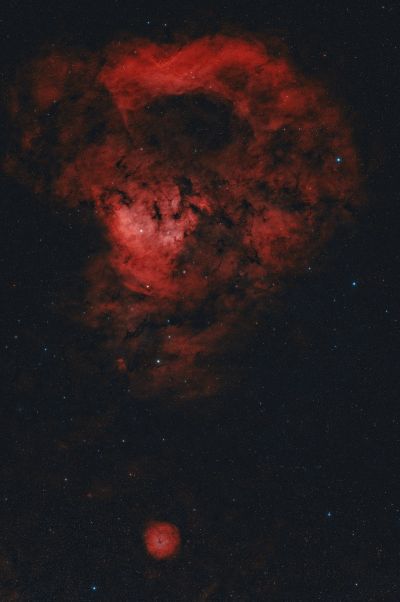
Sh2-221 (left) is a supernova remnant located about 2,600 light-years away from the star that exploded roughly 6,000 years ago. Its diameter is about 130 light-years. The star, once very similar to our Sun and which created the planetary nebula Sh2-216 (right), began slowly dying half a million years ago, making it ancient by planetary nebula standards. Sh2-216 is much closer, about 400 light-years away, and significantly smaller—11 light-years in diameter. It is the second-closest known planetary nebula, as well as the largest and oldest.
The yellow-orange patch above Sh2-221 is Sh2-217. It is part of a larger star-forming region and contains about 4,100 solar masses of material. The star-forming region mentioned above is very young for such objects, only 4 million years old. Sh2-217 is about 13,700 light-years away and spans about 35 light-years at its widest point. The smaller object Sh2-219, which appears to sit on the right shoulder of Sh2-221, is part of the same star-forming region as Sh2-217 and lies at roughly the same distance from us. The emission nebula BFS 44/LBN 755 in the lower part of the frame between the two large objects is also part of the same star-forming region.
Just a couple of nights so far—I’ll keep collecting more data.




Comments
It's an interesting object, but can't you add oxygen?
Comments are available only to registered users. Register or log in to leave a comment.