Thank you for sharing your photos - this is exactly what this project is all about! :-)
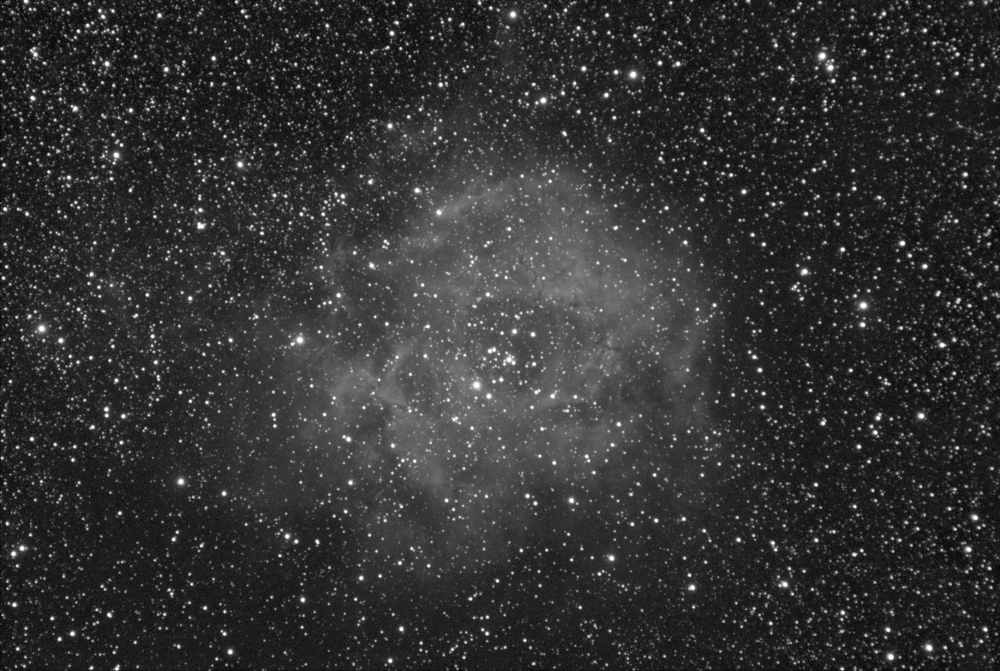
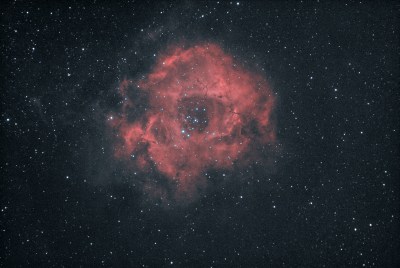
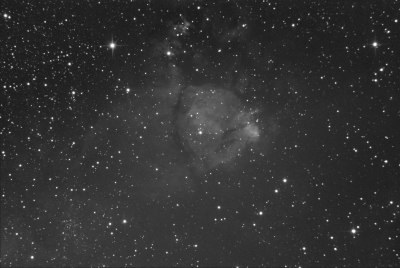
The Rosette Nebula, or NGC 2237—at least that designation refers to part of it. The nebula is located in the constellation Monoceros, positioned somewhat east and south of the bright star Betelgeuse (Alpha Orionis) in the sky. It is one of the most famous and beautiful gas and dust nebulae. At the center of the nebula, the open star cluster NGC 2244 can be observed, composed of young blue stars. (Discovered by John Flamsteed in 1690.) The distance to the nebula is approximately 5,200 light-years. Its diameter is about 130 light-years. The mass of the nebula is estimated to be around 10,000 solar masses. Due to an abundance of hydrogen, the nebula appears with a reddish hue in most photographs. The entire nebula is threaded with dark dust filaments, some of which are clearly distinguishable in the image. Observations reveal the presence of rapidly moving molecular clumps, the origin of which remains unclear to this day.
Yes. But besides the cutoff filter, I also used a red filter, a very cheap one. However, it significantly improved the aesthetics. So this is not a pure L-channel.
Yes, from the description, I understand there were two filters in the optical path. With a narrowband filter, it will be even more interesting—the stars will appear even smaller.
The issue (blue shift) occurs with narrowband filters at large apertures (f/2.0-f/2.8). At f/3.5 or slower, it works fine. I shoot with a 7 nm filter at f/3.33-f/3.5 without complaints—just make sure to calibrate with flats.
No. With narrowband filters, the passband shifts toward the shorter wavelength part of the spectrum with faster (brighter) optics, which can reduce transmission of the desired emission line. However, as mentioned above, for focal ratios of f/2.0 to f/2.8, the effect is significant.
Where is this information coming from? The filter's bandwidth cannot change. The filter doesn't know what optics are in front of it. Now, the distortions introduced by the lens itself are a different matter. But again, if you pass a hydrogen line through even a single, very fast lens, it's unlikely that Hα will turn into OIII. Or am I misunderstanding something?
If I remember, I'll try to find the document where the information came from. It's from an Astrodon presentation on the performance of narrowband filters.

Comments
It will be interesting to read.
Comments are available only to registered users. Register or log in to leave a comment.