Thank you for sharing your photos - this is exactly what this project is all about! :-)
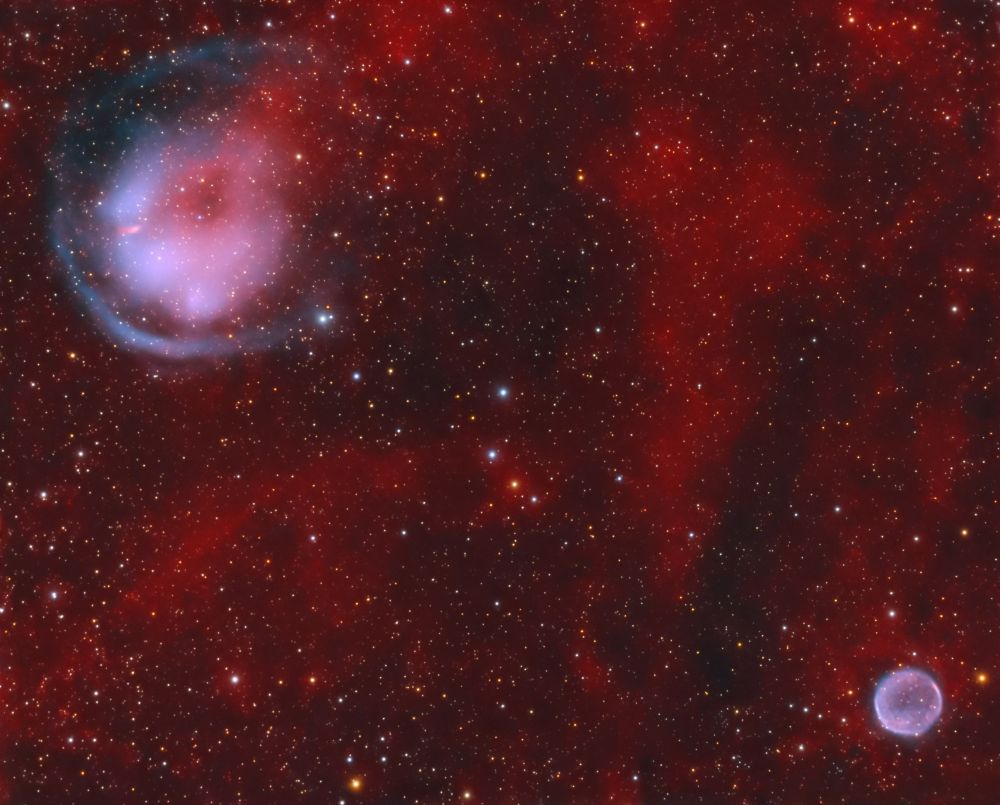
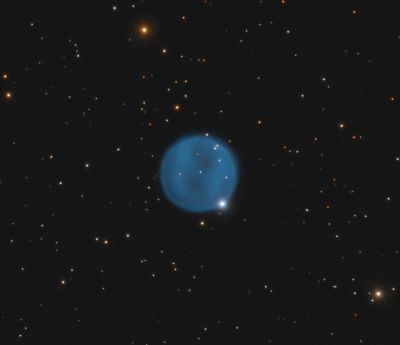
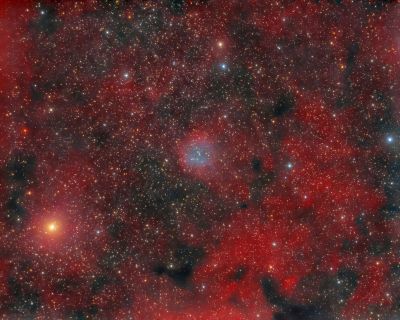
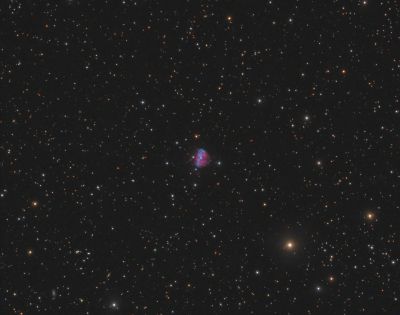
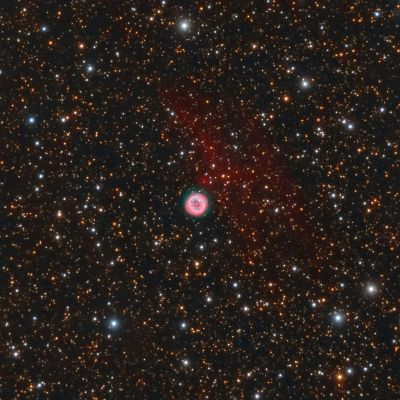
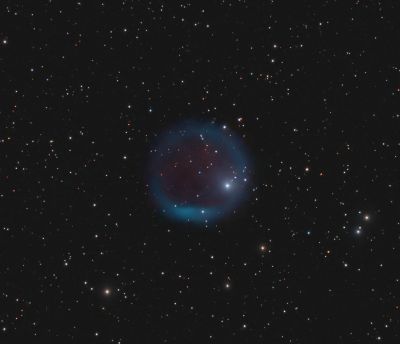
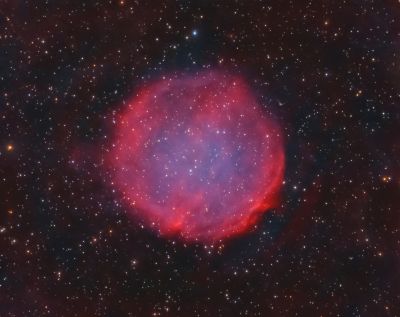
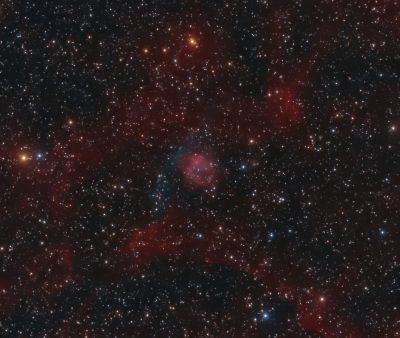
Heckathorn-Fesen-Gull 1 (HFG 1) and Abell 6 - two planetary nebulae among the clouds of hydrogen in the constellation Cassiopeia.
HFG 1 (also known as PK 136+05) is visible in my image in the upper left corner. HFG 1 is a large 8.3 arcminute faint evolved planetary nebula that was discovered in 1982 by Joy Heckathorn, Robert Fesen and Theodore Gull. In 2009, a massive trail of emission was discovered, which is caused by the planetary nebula moving through space and interacting with the interstellar medium. Another indicator of its motion through space and another product of its interaction with the ISM is a mainly OIII bowshock with a size of 15 arcminutes. Another structure associated with this planetary nebula is a Ha low ionisation structure embedded in the central shell. This planetary nebula also has a binary central star called V664 Cassiopeiae. The two stars are very close and rotate about each other in just 14 hours.
Abell 6 (PK 136+04.1) is a planetary nebula (with size about 3 arcminutes and magnitude of about 15m) in the bottom right corner of my image which is the smaller round bubble-like structure with a brighter wall. This nebula dicovered by George Abell in 1955.
This image taken over several nights in January-March 2021.
R-channel - 24 x 150 sec. bin 1x1;
G-channel - 24 x 150 sec. bin 1x1;
B-channel - 24 x 150 sec. bin 1x1;
Ha- 56 x 600 sec., 14 x 900 sec. bin 2x2;
OIII- 55 x 600 sec. bin 2x2.
Total integration time about 25 hours.
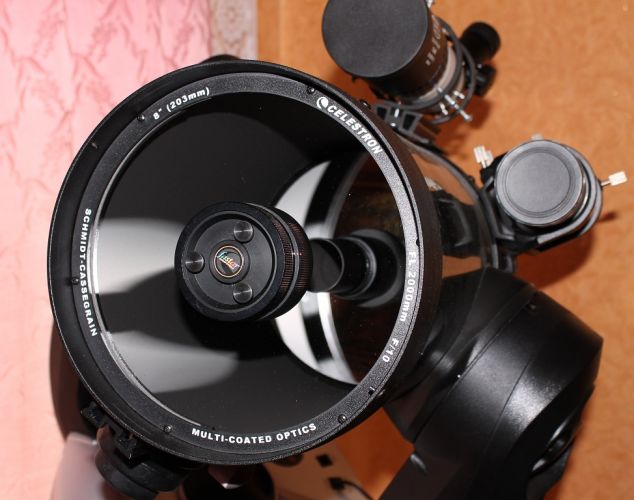
Boris, could you please tell me if you use the native focuser or have installed an external one? And if you have installed an external one, are there any issues with mounting a reducer/corrector? I read somewhere that using reducers on Schmidt-Cassegrains with external focusers can lead to problems with insufficient focuser travel and back focus—making it impossible to achieve focus.
Dmitry, I use an external focuser and also have the option to use the native focusing by moving the primary mirror. I'm hearing for the first time about the inability to focus with a focal reducer. Any lack of focus in the external focuser can always be compensated by adjusting the primary mirror, with any focal reducer.

Comments
Comments are available only to registered users. Register or log in to leave a comment.