Thank you for sharing your photos - this is exactly what this project is all about! :-)
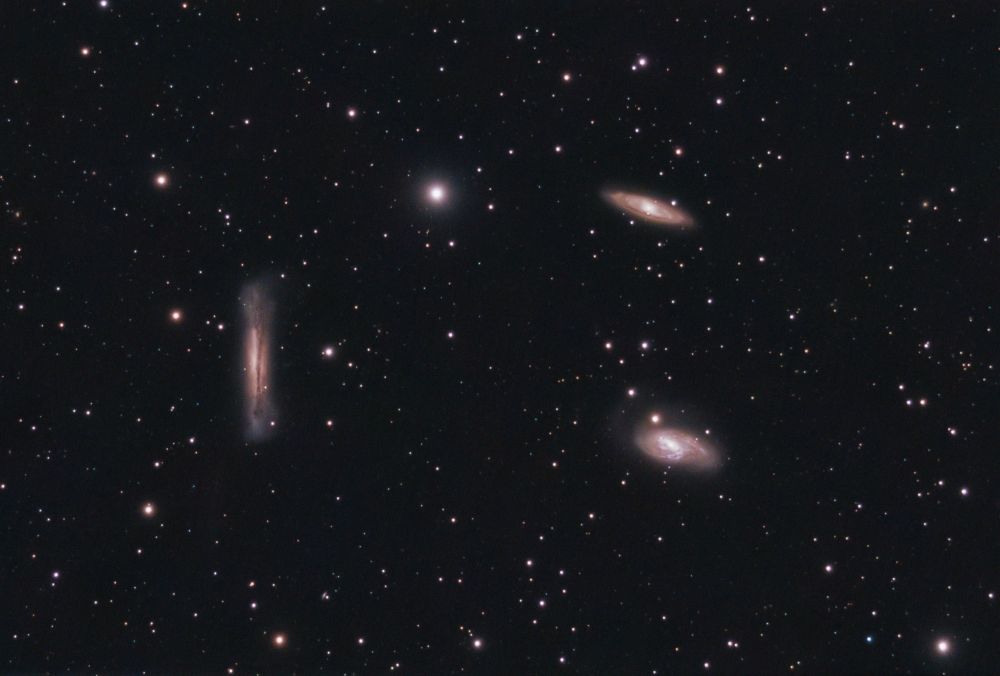
M65, M66, Hamburger Galaxy.
Captured on February 15 and 22. Cooler temperature -35°C. Flats, darks, dark-flats.
— On the first night, I forgot to check the guiding settings and discovered that declination guiding was turned off. This caused noticeable streaks in the background.
— Also on the first night, stars had triple diffraction spikes in their halos, either due to the lens being pinched from the cold or because of protruding collimation screws. By the second night it seemed to have cleared up—not sure if it was because it got warmer or because I backed out the screws by a quarter turn.
— Coma is visible in the corners of the frame. It could be due to incorrect back focus (haven’t fine-tuned it yet) or the reducer just not being suitable for this refractor (on APS-C, coma in the corners with this setup is basically uncorrectable).
— The background is a bit uneven; not sure how else to fix it, but it’s not too noticeable.
— There are some minor guiding issues overall, likely due to the flimsy tube mounting with only one ring and partly loose guide scope attachment.
— On the second night, most of the streetlights in the village were off, but it didn’t seem to help much—light from the city and suburbs dominates the light pollution, especially in winter.
— Shooting at -5°C is much, much, much more pleasant than at -20°C.
Add comment
Comments
There are no comments on this picture yet
Comments are available only to registered users. Register or log in to leave a comment.


Comments
There are no comments on this picture yet
Comments are available only to registered users. Register or log in to leave a comment.